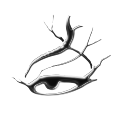
Osteoflora draws upon the tradition of the natural-philosophical understanding of the body and nature—from Baroque memento mori and botanical herbariums to the aesthetics of nineteenth-century scientific illustration, anatomical atlases, and microphotography. These visual traditions, which preserve the fragile materiality of life, become not only a source of imagery but also a way of thinking about time, trace, and transformation.
Osteoflora is a series of works originally created as VR sculptures and further transformed through AI-based image generation. The project explores the fragile interconnectedness of life and death, presenting skeletal forms as imprints of time suspended within ephemeral leaves and petals—as if the memory of nature itself had taken on a tangible form.
Osteoflora is a series of works originally created as VR sculptures and further transformed through AI-based image generation. The project explores the fragile interconnectedness of life and death, presenting skeletal forms as imprints of time suspended within ephemeral leaves and petals—as if the memory of nature itself had taken on a tangible form.
Osteoflora draws upon the natural-philosophical tradition of understanding the relationship between the human body and nature—from Baroque memento mori and botanical herbariums to nineteenth-century scientific illustration, anatomical atlases, and microphotography. These visual languages, which preserve the fragile materiality of life, become not only a source of imagery but also a way of thinking about time, memory, transformation, and the traces left by living beings.
The series originated as VR sculptures and was further transformed through AI-assisted image generation. Here, skeletal structures appear as fossilized imprints of time, suspended within delicate leaves and petals, as though the material memory of nature had become visible. Bones no longer function merely as anatomical remains; instead, they become symbols of continuity, regeneration, and latent growth.
The digital works are presented on LED fan displays beneath transparent acrylic domes, resembling specimens preserved in an anatomical museum or a nineteenth-century cabinet of curiosities. This display creates the effect of a "new formalin"—an imaginary medium in which light itself preserves the image in a state of perpetual oscillation. Rather than freezing life, light measures its pulse, holding the work between
permanence and disappearance.
By combining the materiality of light with themes of digital embodiment and post-organic transformation, Osteoflora continues the search for a contemporary biomedia language. Every element of the installation exists on the threshold between life and decay, support and fragmentation. Bones—the structural foundation of the body and vessels of memory—become paradoxically fertile, suggesting that fragility itself can
become the origin of renewal.
The project resonates with N. Katherine Hayles' concept of the materiality of information (How We Became Posthuman, 1999), proposing that digital media are never purely immaterial but are always experienced through physical substrates. Within Osteoflora, digital images become sensory objects whose
presence depends on light, movement, and the viewer's perception.
The work also echoes Joanna Zylinska's reflections on digital subjectivity, where the body is understood not as a fixed entity but as a constantly evolving process within technological environments. In this context, bones, leaves, and pixels become interchangeable structures through which life continually reorganizes itself.
Finally, the installation enters into dialogue with Boris Groys' writings on media and death. Rather than representing mortality, the work stages a continuous state of transition. The rotating luminous forms neither preserve nor erase life; instead, they inhabit the unstable space between organic fragility and technological permanence, where memory remains in motion rather than becoming static.
MESS {XR Lab}
Curated by Elena Merkulova
OSTEOFLORA 01
Video file for LED fan display (MP4, 1080 × 1080), 2025
OSTEOFLORA 02
Video file for LED fan display (MP4, 1080 × 1080), 2025
OSTEOFLORA 03
Video file for LED fan display (MP4, 1080 × 1080), 2025
OSTEOFLORA 04
Video file for LED fan display (MP4, 1080 × 1080), 2025
OSTEOFLORA 05
Video file for LED fan display (MP4, 1080 × 1080), 2025
OSTEOFLORA 06
Video file for LED fan display (MP4, 1080 × 1080), 2025
OSTEOFLORA 07
Video file for LED fan display (MP4, 1080 × 1080), 2025